The Ultimate At-Home Workout
The Ultimate At-Home Workout: 5 Exercises That Train Almost Your Entire Body
You don’t need a gym to build strength, maintain muscle, or improve your fitness.
You don’t even need a lot of equipment.
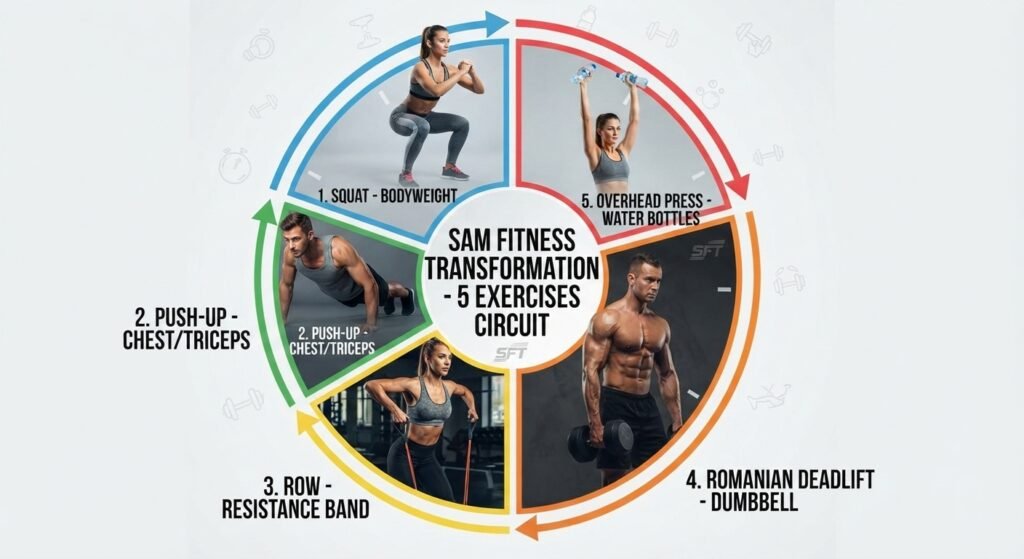
If you choose the right exercises, five simple movements can cover most of the major muscle groups in your body and give you an effective full-body workout at home.
The key isn’t finding dozens of exercises.
It’s choosing a few movements that give you the most return for your time.
The 5 Exercises
1. Squat
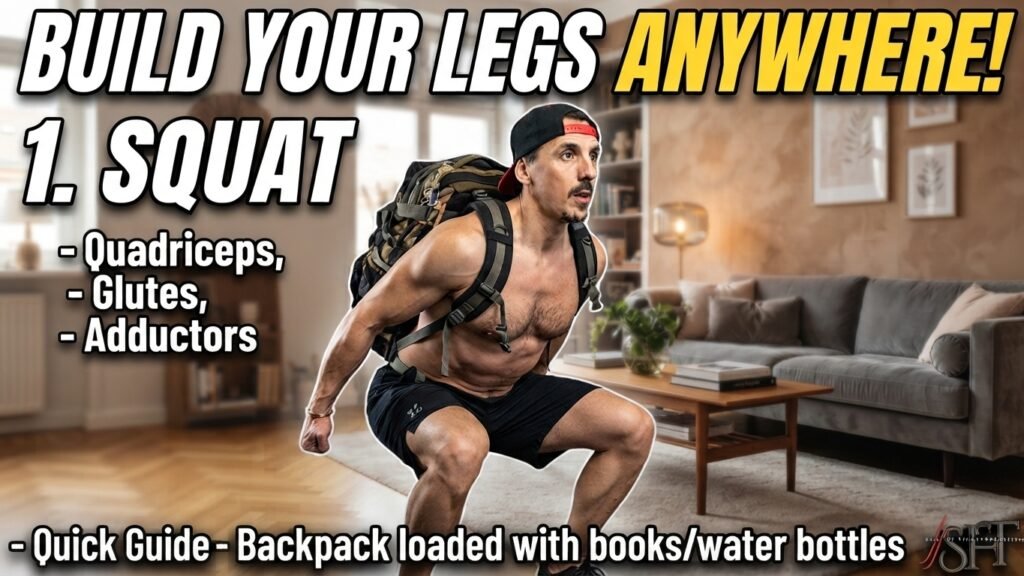
Main muscles: quadriceps, glutes, adductors
The squat is one of the simplest ways to train your lower body.
Start with bodyweight squats. As you get stronger, you can make them harder by holding a backpack loaded with books or water bottles.
How to do it:
- Stand roughly shoulder-width apart.
- Keep your chest up and your core braced.
- Bend your knees and hips simultaneously.
- Lower yourself as far as you can while maintaining good control.
- Push through your feet to return to the starting position.
Beginner: 2–3 sets of 8–15 reps
Progression: Add resistance or use a more challenging variation.
2. Push-Up
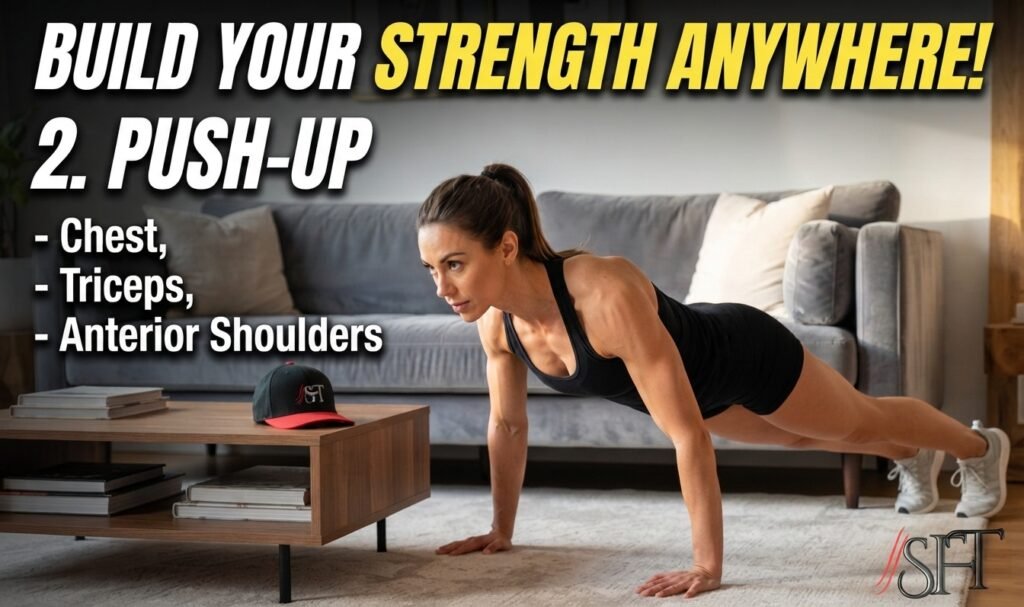
Main muscles: chest, triceps, anterior shoulders
You don’t need a bench press to train your pushing muscles.
A properly performed push-up can provide a surprisingly effective stimulus for your chest, shoulders and triceps.
How to do it:
- Place your hands slightly wider than shoulder-width.
- Keep your body in a straight line.
- Brace your abs and avoid letting your hips sag.
- Lower your chest toward the floor under control.
- Push the floor away to return to the starting position.
If standard push-ups are too difficult, perform them with your hands elevated on a stable table or countertop.
If they’re too easy, slow down the eccentric portion, elevate your feet, or add resistance.
Beginner: 2–3 sets of 6–15 reps
Progression: Increase reps, resistance, or difficulty.
3. Row
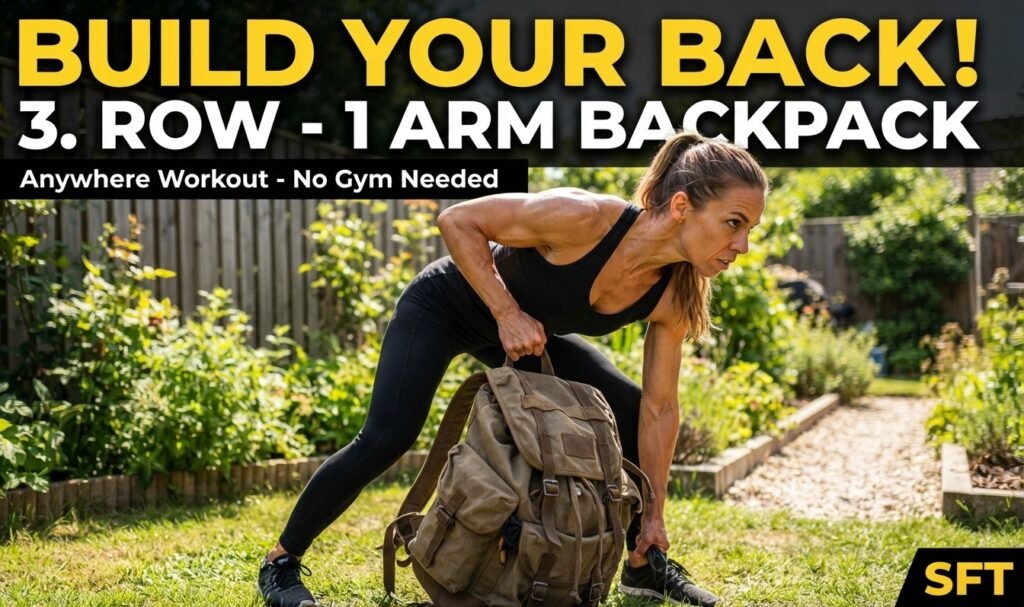
Main muscles: upper back, lats, rear shoulders, biceps
There’s one problem with many home workouts:
They contain plenty of pushing exercises but almost no pulling.
A row fixes that.
You can use a resistance band, dumbbells, or even a sturdy backpack loaded with books.
How to do it:
- Hinge forward at the hips while keeping your back controlled.
- Pull the resistance toward your lower ribs.
- Keep your elbows relatively close to your body.
- Squeeze your back at the top.
- Lower the weight slowly.
Beginner: 2–3 sets of 8–15 reps
Progression: Increase resistance or reps.
Important: Use equipment that is stable and designed to handle the load. Don’t use a bag or object that could break or slip during the movement.
4. Romanian Deadlift
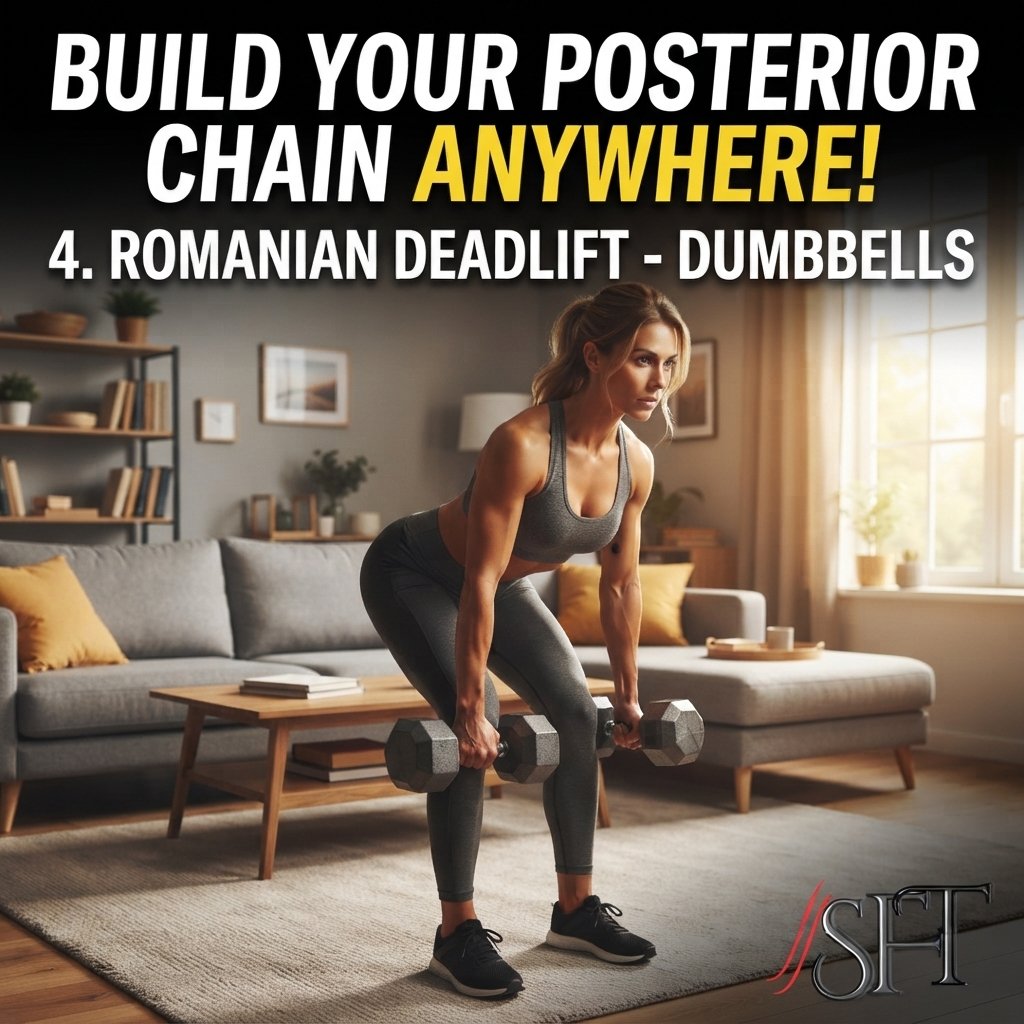
Main muscles: hamstrings, glutes, lower back and posterior chain
The squat gives you a lot of knee-dominant work.
The Romanian deadlift gives you something different: a strong hip-hinge movement.
This makes it particularly useful for training the muscles on the back of your legs.
You can perform it with dumbbells, a resistance band, or a loaded backpack.
How to do it:
- Stand tall with the resistance close to your body.
- Push your hips backward.
- Keep a slight bend in your knees.
- Lower the resistance while keeping your spine controlled.
- Stop when you feel a strong stretch in your hamstrings.
- Drive your hips forward to return to standing.
Don’t try to reach the floor at all costs.
Your range of motion should be determined by your mobility and ability to maintain good technique.
Beginner: 2–3 sets of 8–15 reps
Progression: Gradually increase resistance.
5. Overhead Press
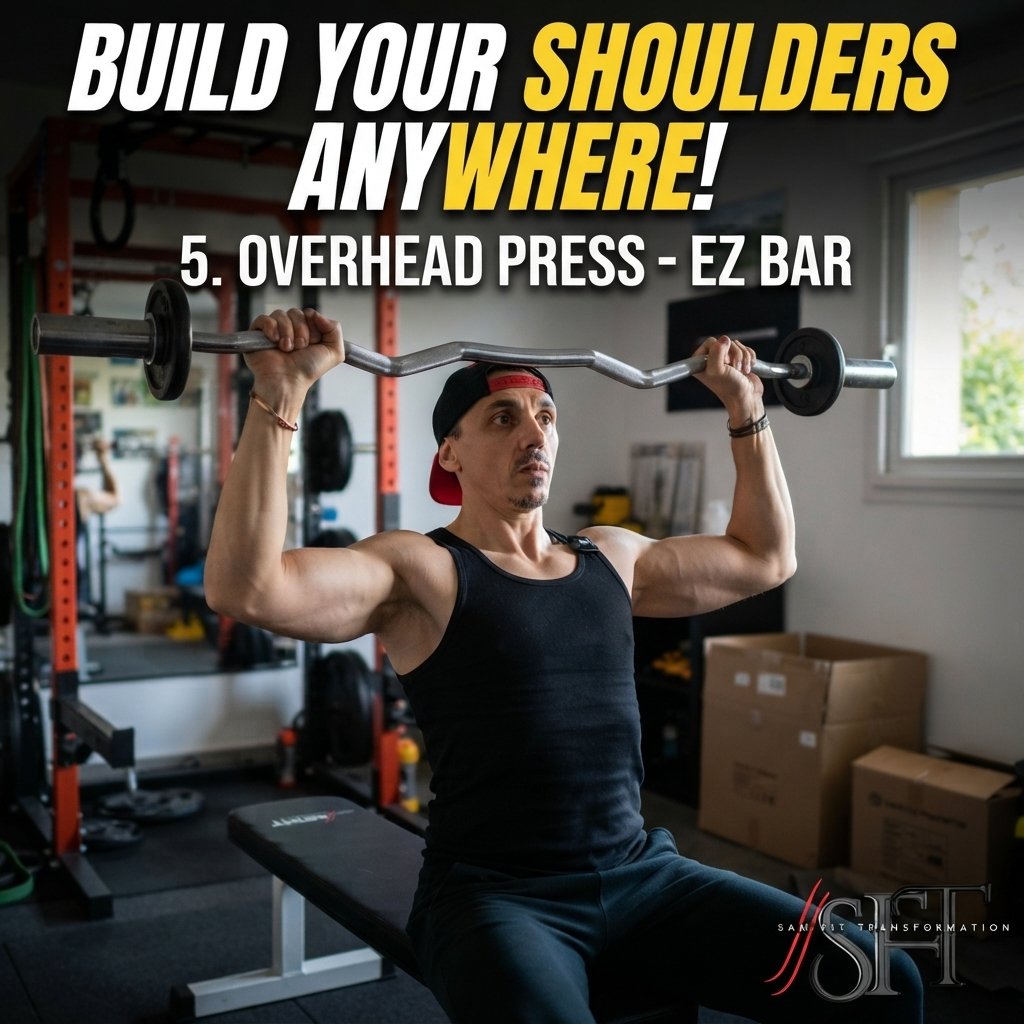
Main muscles: shoulders, triceps and upper chest
The final movement gives us vertical pushing.
You can use dumbbells, resistance bands, or household objects that you can safely control.
How to do it:
- Start with the resistance around shoulder height.
- Brace your core.
- Press the weight overhead.
- Avoid excessive arching of your lower back.
- Lower the resistance under control.
Beginner: 2–3 sets of 8–15 reps
Progression: Increase resistance or reps.
If overhead pressing causes pain, don’t force the movement. A different pressing variation may be more appropriate.
Your Simple 3-Day Home Workout
You don’t need to perform this workout every day.
For most beginners, three non-consecutive sessions per week is a simple and effective starting point.
Workout
1. Squat — 3 × 8–15
2. Push-Up — 3 × 6–15
3. Row — 3 × 8–15
4. Romanian Deadlift — 3 × 8–15
5. Overhead Press — 2–3 × 8–15
Rest roughly 1–3 minutes between sets, depending on the exercise and your level of fatigue.
The workout doesn’t need to last an hour.
For many people, 30–45 minutes is enough.
How to Make It Work
Here’s the part that matters most.
Don’t simply repeat the same workout forever.
Your body adapts to training. If the exercises become easy, you need to gradually increase the challenge.
This is called progressive overload.
You can progress by:
- Adding repetitions
- Adding resistance
- Using a more difficult variation
- Improving your range of motion
- Improving your technique
- Increasing control and reducing unnecessary momentum
For example, if you can comfortably perform 15 push-ups for every set, it’s probably time to make the exercise harder rather than continuing to perform endless sets of 15.
You don’t need to train to absolute failure on every set either.
Finishing a set with a few good repetitions still available can be enough to produce an effective training stimulus, particularly when you’re starting out.
What About Your Abs?
You might have noticed something.
There isn’t a traditional crunch or sit-up in this program.
That’s intentional.
Your core is already heavily involved in stabilizing your body during squats, push-ups, rows, Romanian deadlifts and overhead presses.
That doesn’t mean direct abdominal training is useless.
If you enjoy it or want to develop your abs specifically, you can add 2–3 sets of a core exercise such as a plank, dead bug or reverse crunch at the end of the workout.
But you don’t need ten different abdominal exercises to build a solid foundation.
Why Resistance Training Matters During Fat Loss
If your goal is losing body fat, you might be tempted to focus entirely on cardio.
That’s a mistake.
Resistance training provides an important stimulus to maintain muscle while losing weight. Research also suggests that adding resistance exercise during diet-induced weight loss can help preserve fat-free mass, increase fat-mass loss and improve strength compared with dieting alone.
In other words, if you’re trying to lose fat, the goal shouldn’t simply be to make the number on the scale smaller.
You want to improve your body composition.
That means losing fat while preserving as much muscle and strength as possible.
The Bottom Line
You don’t need a complicated home workout.
You need a handful of well-chosen movements, a reasonable amount of training volume, and a way to progressively make the exercises harder.
With just five movements — squat, push-up, row, Romanian deadlift and overhead press — you can train most of the major muscle groups in your body without a gym.
Start simple.
Train consistently.
Then make the workout progressively harder as you become stronger.
That’s far more effective than constantly searching for the “perfect” exercise.
Want to Take Your Fat Loss Further?
This workout can help you build strength, maintain muscle, and stay active at home.
But if your main goal is losing body fat while preserving muscle, energy, and performance, training is only one part of the equation.
That’s why I created the Ultimate Fat Loss Protocol — a complete, structured approach that brings nutrition, training, recovery, and sustainable fat loss together.
👉 Learn more about the Ultimate Fat Loss Protocol
Scientific Reading
- Resistance exercise during weight loss and its effects on fat-free mass, fat mass and strength: Binmahfoz et al., BMJ Open Sport & Exercise Medicine (2025).
- American College of Sports Medicine — resistance training and physical activity guidelines.
- American College of Sports Medicine — progression models in resistance training for healthy adults.