
Energy Availability: One of the Hidden Reason So Many Diets Fail
Introduction
Most people believe fat loss comes down to one simple rule:
Eat fewer calories than you burn.
And while that’s technically true, it leaves out one critical concept that can determine whether your diet is successful—or whether it slowly destroys your performance, recovery, and motivation.
That concept is Energy Availability.
Outside of sports science, very few people talk about it.
Yet it may explain why two people following the same calorie deficit can have completely different results.
One continues progressing while feeling strong and energetic.
The other feels exhausted, loses muscle, plateaus, and eventually gives up.
The difference isn’t always the size of the calorie deficit.
It’s how much energy is left for the body to function after exercise.
What Is Energy Availability? (Simple Definition)
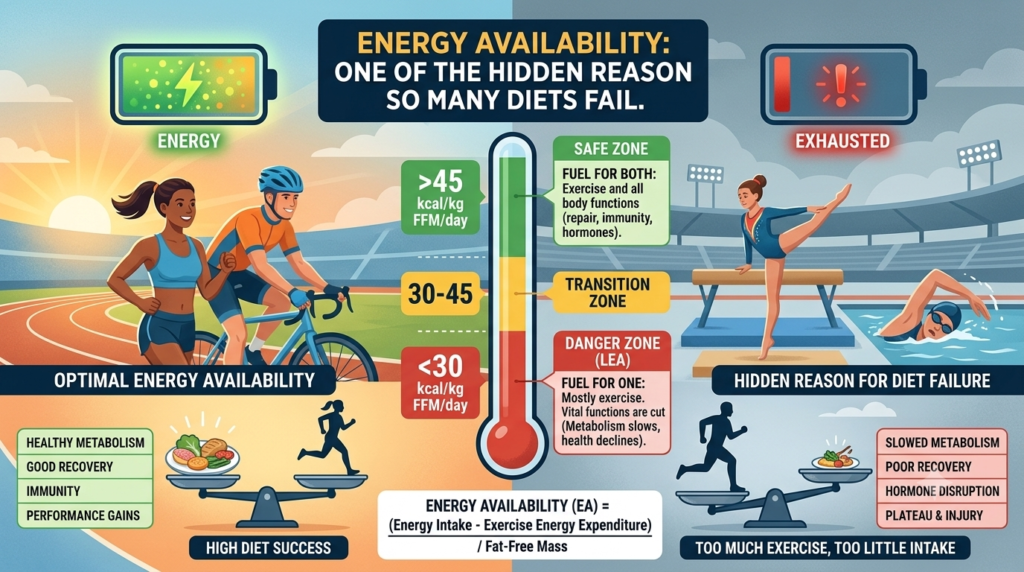
Energy Availability (EA) is the amount of dietary energy left for your body’s normal physiological functions after accounting for exercise.
In other words:
Calories eaten − Exercise calories burned = Energy available for your body.
That remaining energy is used to support:
- hormone production
- immune function
- recovery
- brain function
- muscle repair
- metabolism
- reproductive health
- bone health
Your body doesn’t care that you’re trying to lose fat.
Its first priority is survival.
If too little energy remains after training, it begins shutting down non-essential functions to conserve resources.
Calorie Deficit vs. Low Energy Availability
This is where many people get confused.
These two concepts are not the same.
A calorie deficit simply means:
You burn more calories than you consume.
Low Energy Availability means:
After exercise, there isn’t enough energy left to support normal physiological function.
You can absolutely be in a calorie deficit without developing Low Energy Availability.
Likewise, you can create a relatively small calorie deficit but train so much that your available energy becomes critically low.
This distinction is one of the biggest reasons many diets fail.
=> struggle to burn fat ? Learn why here
Why Low Energy Availability Is a Problem
When energy availability becomes too low for too long, the body begins adapting.
You may notice:
- persistent fatigue
- declining gym performance
- slower recovery
- increased hunger
- irritability
- poor sleep
- loss of muscle mass
- reduced motivation
- weight-loss plateaus
Many people interpret these signs as a lack of discipline.
In reality, they’re often signs that the body no longer has enough energy to recover properly.
=> learn more about adative thermogenesis here
Why Athletes Have Studied This for Years

In sports nutrition, Low Energy Availability is a well-established concept.
Researchers have shown that prolonged inadequate energy availability can negatively affect:
- metabolic rate
- endocrine function
- immune system
- bone health
- muscle protein synthesis
- training adaptations
The condition is now recognized within the framework known as Relative Energy Deficiency in Sport (RED-S).
Although RED-S was first described in athletes, the underlying physiology applies to anyone combining calorie restriction with high training volumes.
My Experience
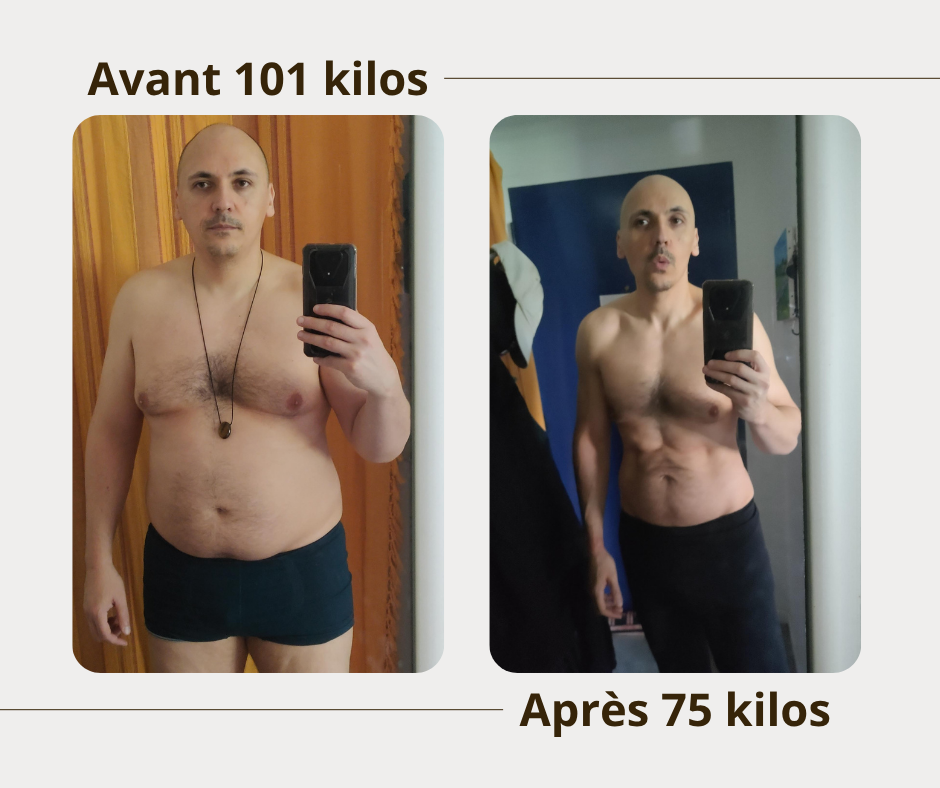
When I lost 58 lbs after the age of 40, I made the same mistake many people make.
Whenever progress slowed, my first instinct was simple:
Eat less.
Train more.
At first, it seemed logical.
But eventually I noticed something else.
My workouts became harder.
Recovery slowed.
Fatigue accumulated.
I wasn’t just creating a calorie deficit.
I was reducing the energy my body had available to function.
Once I understood this difference, everything changed.
Instead of constantly pushing harder, I began managing my deficit more intelligently.
Strategic refeeds.
Planned diet breaks.
Adequate protein.
Resistance training focused on preserving muscle.
The goal was no longer to eat as little as possible.
The goal was to lose fat while giving my body enough energy to recover and perform.
Ironically, progress became more consistent once I stopped trying to maximize restriction.
learn more about my journey here
How to Stay in a Deficit Without Sacrificing Recovery
A successful fat-loss phase doesn’t require suffering.
It requires planning.
Some practical strategies include:
- Keep calorie deficits moderate rather than extreme.
- Prioritize resistance training over excessive cardio.
- Maintain a high protein intake.
- Monitor recovery and training performance.
- Include diet breaks or refeeds when appropriate.
- Avoid chasing the fastest possible rate of weight loss.
=>learn more about glycogen and fat loss
Fat loss is a marathon.
The objective isn’t to survive a few weeks.
It’s to reach your goal while keeping your metabolism, muscle mass, and motivation intact.
Scientific Perspective
Energy Availability (EA) is typically expressed as:
EA = (Energy Intake − Exercise Energy Expenditure) ÷ Fat-Free Mass (kg)
In sports nutrition, an Energy Availability of approximately 45 kcal/kg of fat-free mass per day is considered optimal for maximizing physiological function in athletes. However, during a fat-loss phase, many individuals intentionally operate below this level. The goal is not necessarily to maintain optimal Energy Availability, but to avoid chronically low levels—generally below 30 kcal/kg FFM/day—which are associated with impaired recovery, hormonal disruption, and reduced training adaptations.
Importantly, these thresholds come primarily from athletic populations and should not be interpreted as rigid cut-offs for everyone.
The key principle remains the same:
The body needs enough available energy to recover, adapt, and maintain normal physiological processes.
Creating a calorie deficit does not automatically mean creating Low Energy Availability.
The goal is to reduce body fat—not to deprive the body of the energy it needs to function.
Final Thoughts
A calorie deficit is necessary for fat loss.
Low Energy Availability is not.
Understanding the difference changes everything.
The best fat-loss strategy isn’t the one that creates the largest deficit.
It’s the one that allows you to lose fat while continuing to train well, recover properly, preserve muscle, and stay consistent.
Because consistency—not exhaustion—is what produces lasting results.
Scientific Sources
Mountjoy, M., Sundgot-Borgen, J., Burke, L., et al. (2023). IOC Consensus Statement on Relative Energy Deficiency in Sport (RED-S): 2023 Update. British Journal of Sports Medicine.
Loucks, A. B. (2004). Energy Balance and Body Composition in Sports and Exercise. Journal of Sports Sciences.
Loucks, A. B., Kiens, B., & Wright, H. H. (2011). Energy Availability in Athletes. Journal of Sports Sciences.
Thomas, D. T., Erdman, K. A., & Burke, L. M. (2016). Position of the Academy of Nutrition and Dietetics, Dietitians of Canada, and the American College of Sports Medicine: Nutrition and Athletic Performance. Journal of the Academy of Nutrition and Dietetics.